Car Air Conditioning Repair Guide
You usually notice air-con trouble on the worst possible day – stuck in traffic, heading up the coast, or towing a van with the cabin turning into an oven. A good car air conditioning repair guide helps you sort the simple signs from the faults that need proper testing, so you do not waste money on guesses or temporary fixes.
Vehicle air-conditioning systems look straightforward from the driver’s seat. Press a button, set the fan, and expect cold air. Behind that, though, there is a sealed refrigerant circuit, electrical controls, pressure sensors, condenser airflow, cabin filtration, and a compressor that all need to work together. When one part falls over, the symptom can look the same as several different faults.
That is why proper diagnosis matters. Re-gassing a system that has a leak may give short-term relief, but it does not solve the reason refrigerant was lost in the first place. Likewise, replacing a compressor without checking pressures, switch signals, clutch operation, and condenser condition can turn into an expensive guess.
What a car air conditioning repair guide should help you identify
Most drivers are not trying to become air-con technicians. They just want to know what is likely wrong, what is safe to check themselves, and when it is time to book the car in. The main symptoms usually fall into a few groups.
If the air is blowing but not cold, the issue could be low refrigerant, a weak compressor, a condenser fan problem, a blocked cabin filter, or a blend door fault inside the dash. If the air starts cold and then turns warm, pressure may be climbing too high, the evaporator sensor may be playing up, or the compressor could be cutting in and out.
If there is little airflow from the vents, the fault may not be in the refrigerant side at all. A blocked cabin filter, failing blower motor, damaged resistor, or fan speed control issue can all reduce airflow. If there is a bad smell, moisture build-up or mould around the evaporator may be part of the problem.
Then there are the obvious warning signs: oily residue around hose fittings, hissing noises, compressor squeal, clicking relays, or water where it should not be inside the cabin. Each points in a different direction, and that is where methodical testing saves time.
The basic repair path
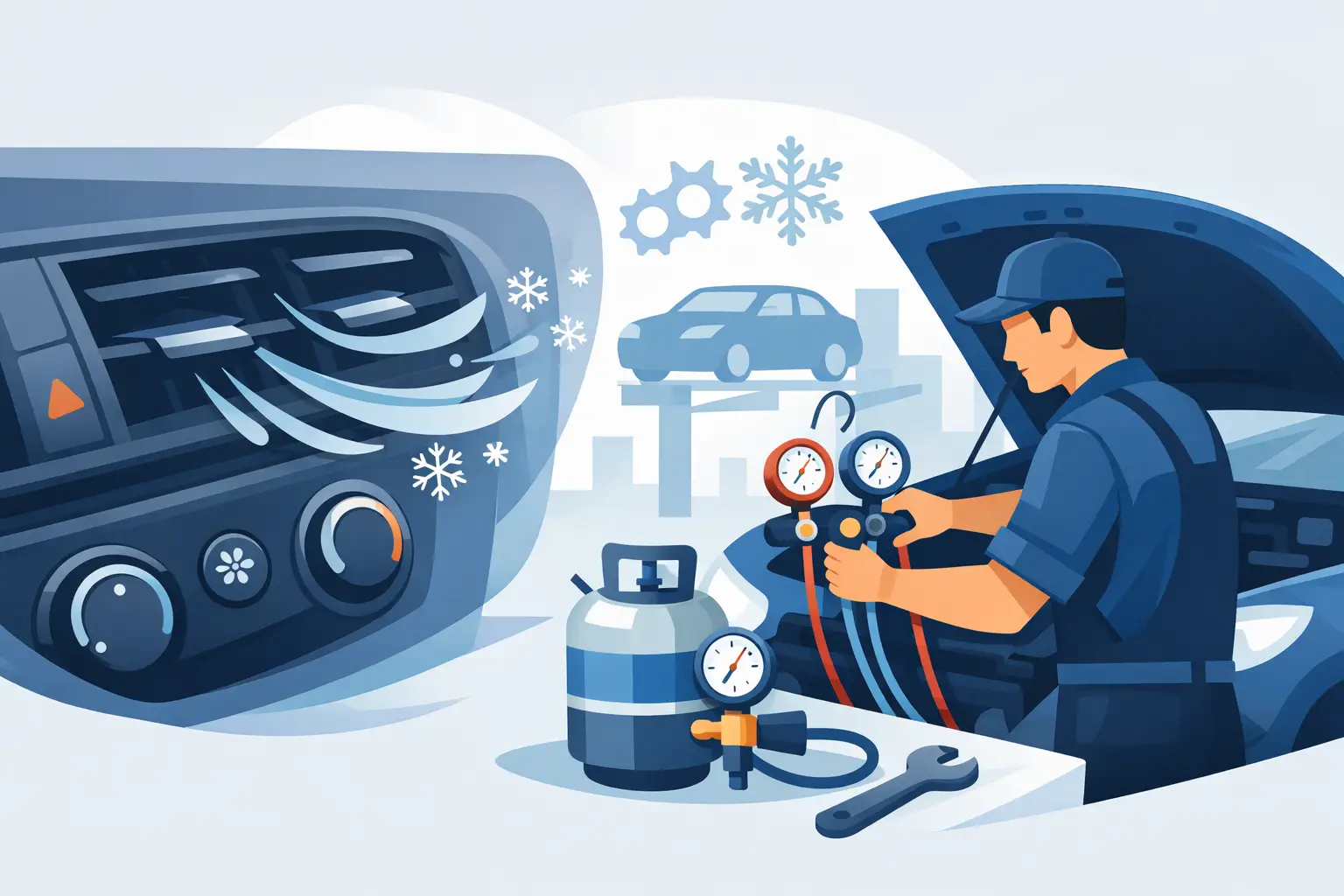
A reliable repair process starts with confirming the complaint. It sounds simple, but air-con faults can be intermittent. A technician will usually check vent temperature, system pressures, compressor engagement, condenser fan operation, and whether the fault changes at idle versus road speed.
From there, leak detection is often the next step if refrigerant charge is low. Refrigerant does not get used up like engine oil. If charge is down, it has usually escaped somewhere. Common leak points include service ports, hose crimps, condenser cores, compressor shaft seals, evaporators, and O-rings.
Electrical checks matter just as much. Modern systems rely on pressure transducers, temperature sensors, relays, control modules and wiring integrity. A compressor that does not switch on is not always a failed compressor. It might be a pressure lockout, a blown fuse, a fan fault, or a control signal issue.
Only after testing should repairs be quoted. That may involve replacing a leaking component, repairing wiring, changing a receiver drier, flushing contamination from the system, evacuating, vacuum testing and then recharging to the correct specification. On many vehicles, getting cold air back is not just about putting refrigerant in and hoping for the best.
Common air-con faults and what they usually mean
Low refrigerant is one of the most common causes of poor cooling, but it is really a symptom rather than a root cause. A very small leak may take months to show up. A larger leak can leave you with no cooling at all within days.
Condensers are another regular problem, especially on vehicles that spend time on highways, gravel roads, worksites or touring routes. They sit up front and take the hit from stones, debris and corrosion. A damaged condenser can leak refrigerant or lose efficiency even before it leaks.
Compressors fail in different ways. Sometimes the clutch does not engage. Sometimes the internal pumping side wears out and pressures are no longer right. In worse cases, the compressor can contaminate the whole system with debris. When that happens, replacing just the compressor is rarely enough. The system may also need flushing and other components replaced to avoid repeat failure.
Cooling fans and airflow issues are often overlooked. If the condenser cannot shed heat properly, vent temperatures suffer, especially at idle. That is why some vehicles seem colder on the highway than they do sitting at the lights.
Inside the cabin, blocked filters and blend door faults can also mislead people. You might think the system needs regassing when the real issue is poor airflow or warm air mixing back in through a faulty air-direction door.
What you can check yourself before booking a repair
There are a few sensible checks any owner can make without touching the sealed refrigerant system. Start with the basics. Make sure the air-con is actually switched on, the temperature is set to cold, and the fan speed changes properly across its settings.
Check whether airflow is weak from all vents or just some. If your vehicle has a cabin filter and it has not been changed in a while, that is worth inspecting. A badly blocked filter can choke airflow and make the whole system seem ineffective.
With the engine running and air-con on, listen for changes when the system is switched on and off. You may hear the engine load alter slightly or the condenser fans come in. If nothing changes at all, that is useful information for diagnosis.
Also look under the bonnet for obvious damage around the front condenser area, but avoid poking around moving belts and fans. If you spot oily grime on fittings or hoses, that can indicate a refrigerant leak. If there is water dripping under the car on a hot day, that is often normal evaporator drain water. If that water is ending up on the passenger floor instead, the drain may be blocked.
What you should not do is try random top-up cans or leak-stop products. These can complicate proper repairs, contaminate service equipment, and turn a straightforward job into a bigger one.
When a regas helps and when it does not
A regas has its place, but only when the system condition justifies it. If refrigerant charge is slightly low and the cause has been identified and repaired, evacuating and recharging the system correctly is part of the fix. If the system is empty because of a leak, a regas on its own is not a repair.
The same goes for older vehicles that have gradually lost performance over time. Sometimes they do need refrigerant corrected to factory spec. Sometimes the real issue is condenser airflow, compressor wear, or a failing control valve. It depends on the test results, not just the cabin temperature.
For people who rely on their vehicle for work, family trips, or towing a caravan, this is where spending money on diagnosis first usually pays off. It reduces the chance of paying twice.
Why modern vehicles need proper diagnosis
Air-conditioning is now tied into broader vehicle electronics more than many people realise. Some systems vary compressor output electronically. Some monitor ambient temperature, evaporator temperature, sun load and cabin settings through modules. Hybrid and specialty systems add another layer again.
That means an accurate repair can involve more than gauges and refrigerant scales. Scan data, electrical testing and a clear understanding of the control strategy all matter. This is especially true when the fault is intermittent, linked to engine temperature, or triggered only under load.
For 4WDs, campervans and touring vehicles, there can also be overlap with accessory electrical work. Extra fans, battery systems, poor wiring practices or aftermarket installations can sometimes affect charging, fan operation or control circuits. Not always, but often enough that it is worth having someone look at the whole picture rather than one symptom in isolation.
What affects repair cost
Air-con repair cost depends on what has failed, how accessible the component is, and whether contamination is involved. Replacing a service valve or repairing a simple leak is very different from dash-out evaporator work. A failed compressor with debris through the system is a bigger job again.
Vehicle type matters too. A compact passenger car is one thing. A 4WD, ute, campervan or vehicle with rear air can mean more components, more labour and more refrigerant. Parts quality also makes a difference. Cheap components may reduce the upfront bill, but they are not always the best value if they compromise reliability.
A decent workshop should explain what they found before repairs go ahead, what needs replacing now, and what can be monitored. That kind of clarity matters just as much as the cold air.
Car air conditioning repair guide: when to stop guessing
If your system is not cooling, keeps cutting out, makes noise, smells off, or has already been regassed once without lasting improvement, it is time for proper diagnosis. That is particularly true before a long trip, during summer, or if your vehicle doubles as a workhorse and travel setup.
At Coastal Cool Air, that practical approach matters because people are not just chasing comfort. They are protecting reliability for school runs, job sites, weekend trips and longer touring plans.
Cold air should not be a lucky break. If your air-con is playing up, treat the symptoms as clues, not answers, and you will usually end up with a better repair and fewer surprises later.