
Car Cooling Fan Diagnosis Made Simple
You usually notice a cooling fan problem at the worst possible time – idling in traffic with the air-con on, crawling up a range road, or pulling into camp after a long summer run. The gauge starts creeping higher than normal, the A/C stops feeling properly cold, and suddenly car cooling fan diagnosis goes from a workshop term to something you need sorted quickly.
The cooling fan has a straightforward job, but the system around it is not always simple. On most modern vehicles, the fan helps pull air through the radiator when road speed is too low to do the job naturally. In many cases it also supports condenser cooling for the air-conditioning system. When it stops working properly, you can end up with overheating, poor A/C performance, higher engine stress, and in some cases a vehicle that behaves perfectly on the move but struggles badly at idle.
Why car cooling fan diagnosis matters
A failed fan is not just an inconvenience. If the engine runs too hot, the damage can escalate quickly from a manageable electrical repair to a warped cylinder head, failed gasket, or cooling system overhaul. For drivers who tow, run a loaded 4WD, or travel in hotter conditions, the margin for error gets smaller.
There is also the air-conditioning side of it. Many people book in because the A/C is weak at the lights but improves once the vehicle is moving. That pattern often points to airflow problems, and the cooling fan is one of the first things worth checking. If the condenser is not getting enough airflow at idle, cabin vent temperatures can rise even if the refrigerant charge is otherwise fine.
Common signs the cooling fan system has a fault
Some faults are obvious, others are more subtle. The classic symptom is an engine temperature gauge that climbs while stationary but settles down once you get moving. Another common sign is air-conditioning that works better at speed than it does in traffic or while parked.
You may also hear the fan running constantly, even when the engine is cold, which can point to a control issue rather than a mechanical one. In other cases, the fan may not come on at all, or it may cycle at the wrong times. Some vehicles log fault codes related to fan control circuits, coolant temperature sensors, or air-conditioning pressure inputs. Others do not give much warning beyond heat.
If you drive a touring vehicle, campervan or work ute, pay attention to changes under load. A marginal fan motor or relay may cope with short local trips but show its weakness when ambient temperatures are up and the engine bay is under sustained heat.
What causes cooling fan problems?
The fan itself is only one part of the system. A proper diagnosis looks at the full chain, because replacing the motor without testing the controls can waste time and money.
Fan motor failure
This is one of the more common faults, especially on older vehicles. Electric fan motors wear out, draw the wrong current, seize, or become intermittent when hot. Sometimes the fan still spins, but not with enough speed or force to move useful air through the radiator and condenser.
Relay, fuse or wiring faults
A blown fuse can be the simple answer, but it is rarely wise to stop there. Fuses usually blow for a reason. A failing motor can overdraw current, wiring can rub through, connectors can corrode, and relays can stick or fail to switch reliably. Heat and vibration do not do electrical components any favours.
Faulty temperature sensor or control signal
The fan usually relies on input from the engine coolant temperature sensor, the ECU, and in some setups the air-conditioning pressure system. If the sensor is reading incorrectly, the fan may not be commanded on when needed. The opposite can happen too – the fan may run when it should not.
Fan control module issues
Some vehicles use a dedicated fan control module or resistor arrangement to manage different fan speeds. When that unit fails, you may lose low speed, high speed, or fan operation altogether. This matters because a fan that only works on one speed may still appear functional during a quick check, even though it is not operating as designed.
Mechanical cooling system problems
Not every overheating complaint is a fan fault. A sticking thermostat, blocked radiator, low coolant level, failing water pump, or trapped air in the system can produce similar symptoms. Good car cooling fan diagnosis means separating airflow problems from broader cooling system faults.
How a proper diagnosis is done
The best approach is methodical. Guesswork is expensive in automotive electrical and cooling systems, especially on newer vehicles where multiple modules interact.
A technician will usually start by confirming the symptom. Does the engine overheat only at idle? Does the A/C lose performance when stationary? Does the fan fail to run at all, or does it run at the wrong time? Reproducing the fault matters because intermittent issues can be missed if the vehicle is only checked cold in the workshop.
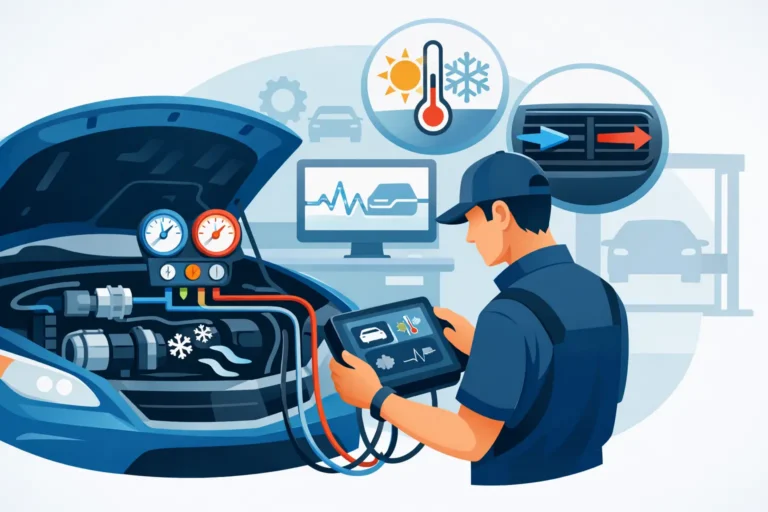
From there, the basics come first. Coolant level, visible leaks, radiator condition, fan blade condition, connector security and fuse integrity are all worth checking. After that, scan tool data often helps. Live readings from coolant temperature sensors, A/C pressure values and ECU fan commands can show whether the vehicle is asking for fan operation and whether the system is responding.
Direct electrical testing is often the difference between a proper diagnosis and a parts swap. That may include checking voltage supply at the fan, testing relay operation, measuring current draw, inspecting earth quality, and confirming whether a control module is sending the correct output. In some cases the fan motor passes a bench test when cold but fails once heat builds up, so load testing under real operating conditions can be necessary.
When the issue is really an air-con complaint
This is where experience counts. A driver might come in saying the air-con is not cold enough, but the refrigerant circuit is only part of the story. If the condenser cannot get airflow because the cooling fan is lazy, non-operational or not switching to the correct speed, vent temperatures will suffer at idle.
That is why cooling fan checks and A/C diagnostics often overlap. It is also why topping up refrigerant without testing fan operation can miss the actual fault. If the fan system is the problem, the air-con may still disappoint after a regas.
Repair decisions depend on the fault
Some jobs are straightforward. A failed fuse, worn relay or damaged connector may be a relatively contained repair. Other cases involve replacing the fan assembly, repairing wiring, or tracing an ECU control problem. It depends on what testing shows.
There are trade-offs as well. On some vehicles, replacing only the motor may be possible. On others, the complete fan assembly makes more sense because the shroud, module or blades are part of the problem. Cheap aftermarket parts can also be false economy if airflow, durability or electrical performance are below standard. For vehicles that spend time towing, travelling, or working hard in Queensland heat, quality matters.
What you can check before booking in
There are a few sensible checks an owner can make without turning it into a driveway experiment. If the engine is overheating, do not keep driving it and hope for the best. Let it cool properly before inspecting anything around the radiator area.
You can look for obvious signs such as coolant loss, damaged fan blades, loose plugs, or a fan that never runs with the air-con switched on while the engine is at operating temperature. You can also pay attention to patterns – only hot in traffic, only with A/C on, only when towing, or only on very hot days. Those details help narrow things down.
What is not worth doing is randomly replacing sensors, relays and fan motors because someone online had a similar symptom. The same complaint can come from very different faults.
When to get it checked promptly
If the temperature gauge is rising above normal, the vehicle is warning of overheating, coolant is boiling, or the air-con performance suddenly changes at idle, it is worth getting the system tested sooner rather than later. The longer an overheating issue continues, the more likely it is to create a second, more expensive repair.
For drivers around the Sunshine Coast and hinterland, this becomes even more relevant heading into hotter weather or before a towing trip, remote run or family holiday. A cooling fan issue that seems manageable around town can become a major problem once the vehicle is loaded up and ambient temperatures climb.
A dependable workshop will explain what has been tested, what has failed, and what actually needs replacing before repairs go ahead. That matters, because cooling fan faults sit right at the intersection of engine cooling, air-conditioning performance and electrical diagnostics.
If your vehicle is running hotter than it should or the air-con only behaves once you are moving, treat it as an early warning rather than a minor annoyance. Catching a fan fault early is usually far cheaper than finding out how hot an engine can really get.