Caravan 12V Power Planning Guide
A good caravan 12V power planning guide starts with one uncomfortable truth – most power problems on the road are designed in long before the first trip. Flat batteries, fridges cutting out overnight, lights dimming by morning, and inverters tripping under load usually come back to poor planning, not bad luck.
If you want a van that works properly off-grid, the goal is simple. Your battery capacity, charging inputs and daily power use all need to match the way you actually travel. Not the brochure version of your trip, and not a mate’s setup that somehow works for him. Your van needs to suit your appliances, your camp style and how often you move.
What a caravan 12V power planning guide should cover
A proper plan is not just choosing a battery and adding a solar panel. It starts with understanding your loads, then working out how much usable battery capacity you need, how you will recharge it, and whether the wiring and components are up to the job.
That matters because 12V systems are sensitive to voltage drop, charging quality and battery chemistry. Two caravans with the same battery size can perform very differently depending on cable sizing, charger setup, alternator charging, solar regulator quality and whether high-draw appliances are being used sensibly.
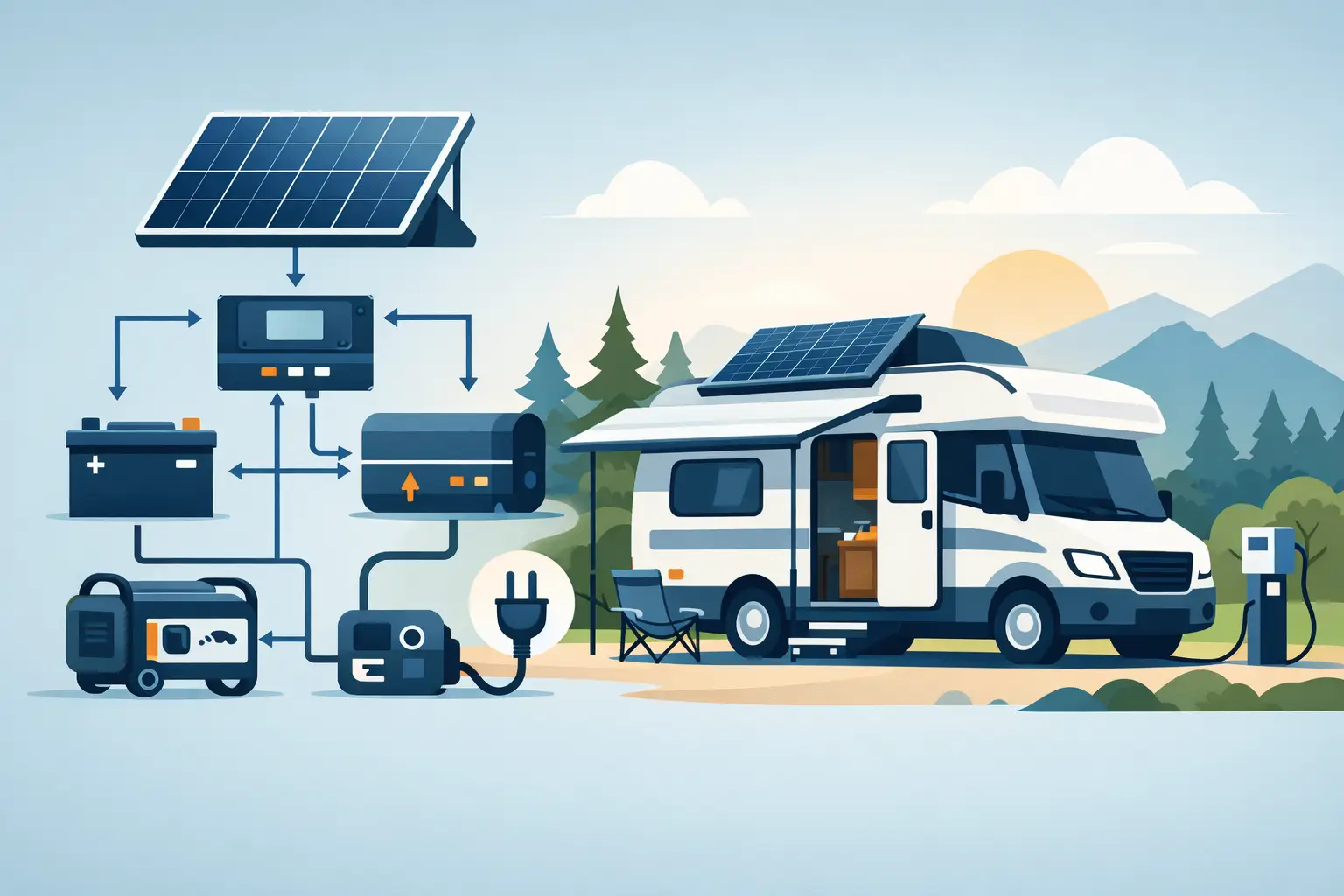
In practical terms, you are planning around four things. First is what you run each day. Second is how long you want to stay put. Third is how you recharge while travelling or camped. Fourth is how much margin you want when conditions are less than ideal.
Start with your real daily power use
This is where most people either overbuild and overspend, or underbuild and spend their trip managing power instead of enjoying it. The right approach is to estimate what you actually use in amp-hours per day, then add a sensible buffer.
Your caravan fridge is usually one of the bigger constant loads, especially compressor fridges in warm weather. Lighting is generally modest if it is all LED. Water pumps, fans, phone charging and a diesel heater controller usually add up to less than people expect. Inverters are where things can jump quickly. A coffee machine, toaster, induction cooktop or hair dryer will change the whole conversation.
A van used for weekend stops with a fridge, lights, water pump, TV and device charging is very different from a full-time touring setup running laptops, a work station, internet gear and occasional 240V appliances through an inverter. If you are unsure, it is worth listing each appliance, roughly how long it runs per day, and whether it runs directly on 12V or through an inverter.
As a rough guide, many touring vans land somewhere between 60Ah and 150Ah per day. That is a broad range because travel style matters more than van size. If you rely heavily on inverter loads, your daily use can move well beyond that.
Battery sizing is about usable capacity, not just battery size
Once you know your likely daily consumption, you can start sizing the battery bank properly. This is where lithium and AGM differ in a big way.
With AGM batteries, only part of the rated capacity is realistically usable if you want decent battery life. A 200Ah AGM bank does not behave like 200Ah of everyday usable storage. With lithium, particularly quality lithium systems designed for off-grid use, a much larger portion of the capacity is usable, voltage stays more stable, and recharge rates are typically better.
That is why a smaller lithium setup can often outperform a larger AGM setup in real use. But chemistry is only part of the picture. Battery size should still be based on how long you want to stay off-grid without relying on ideal sun every day.
If you use 100Ah a day and want two days of comfortable autonomy, you do not want a battery that only just covers that on paper. Weather changes, campsites vary, and some days you use more than expected. A sensible buffer saves frustration.
Solar helps, but it is not magic
Solar is one of the best additions to a caravan power system, but it needs realistic expectations. Panel wattage on a sticker is not what you harvest all day in mixed Australian conditions. Shade, panel angle, heat, regulator quality and the time of year all affect actual input.
If you free camp often, roof solar can do a lot of the daily heavy lifting. But roof space is limited, and caravans are often parked in partial shade to keep the van cool. That creates a trade-off. The best campsite for comfort is not always the best campsite for charging.
Portable solar can help bridge that gap because you can chase the sun while leaving the van in a better position. The downside is setup time, storage, security and the fact that portable panels still need proper regulation and cable sizing.
For many travellers, solar should be treated as a daily recovery source, not the only line of defence. If your battery bank is too small, adding more solar will not always fix the issue, especially during poor weather or in heavily shaded camps.
Driving charge matters more than many people think
If you move regularly, charging from the tow vehicle can be a major part of the system. Done properly, it can keep the van battery topped up between overnight stops and reduce the pressure on solar.
Done poorly, it can be almost useless.
Modern vehicles often need a proper DC-DC charger rather than relying on a basic feed from the alternator. Smart alternators, voltage drop over long cable runs and unsuitable wiring can all reduce charging performance. You might think the van is charging on the move, but the battery may only be getting a token top-up.
This is one of those areas where correct component choice and installation quality matter. Good batteries and solar panels cannot make up for poor charging architecture. If your travel style involves frequent one-night stops, alternator charging becomes even more important.
Inverters change the design
A lot of caravan owners now want the convenience of 240V while off-grid, and that is fair enough. But once an inverter enters the system, especially a larger one, the rest of the setup needs to keep up.
Inverters can draw high current from the battery side, even for short periods. That means cable sizing, fuse protection, battery discharge capability and battery capacity all need to be considered properly. It is not just about whether the inverter can run the appliance. It is about whether the entire system can support that load safely and efficiently.
There is also a common trap here. Some appliances are technically possible to run through an inverter, but not practical if you want decent battery life. A quick coffee might be fine. Running multiple kitchen appliances every morning while expecting modest solar to replace that energy is usually where expectations need adjusting.
Plan the system around how you camp
The best setup for a caravan park user is not the same as the best setup for long-term free camping. If you mostly stay powered, your 12V system can be simpler and smaller. If you spend days away from mains power, self-sufficiency becomes the priority.
Likewise, a couple doing short coastal trips may need something very different from a family travelling inland for weeks at a time. Fans, lighting, charging devices, work gear, entertainment and fridge access all scale differently depending on who is in the van and how they use it.
This is where tailored advice matters. The right answer is rarely the biggest battery you can fit. It is the setup that gives reliable performance without wasting money on capacity or hardware you will never use.
Common mistakes that cause power headaches
Most caravan power issues come from a handful of predictable mistakes. One is underestimating daily consumption, especially inverter loads. Another is assuming solar ratings equal real-world output all day. A third is using battery size as the only measure of system quality while ignoring charging, wiring and protection.
There is also the problem of mixing components that do not work well together. Battery chemistry, charger settings, solar regulation and monitoring should all be compatible. If one part of the system is poorly matched, the whole setup can suffer.
Monitoring is worth mentioning too. A proper battery monitor tells you far more than a simple voltage reading on a wall panel. Without accurate monitoring, many people either worry unnecessarily or discharge batteries harder than they realise.
When to get the system checked professionally
If you already own a caravan and the power never quite keeps up, guessing gets expensive. Replacing batteries without confirming charging performance or load demand often leads to the same problem with newer parts.
A proper assessment should look at current draw, recharge rates, voltage drop, battery health and whether the existing system matches your usage. That is often the quickest way to stop throwing money at symptoms.
For caravan owners around the Sunshine Coast, having a workshop that understands both vehicle charging systems and off-grid caravan power can save a lot of trial and error. Coastal Cool Air works with tailored 12V solutions, so the system is built around real travel use rather than generic package deals.
Good power planning gives you confidence. You stop watching the monitor every hour, stop second-guessing whether the fridge will make it through the night, and start using the van the way it was meant to be used. Get the numbers right, build the system properly, and off-grid travel becomes a lot more relaxing.