How to Choose Lithium Battery Charger
A lithium setup can be brilliant on the road right up until the charger is wrong. That is usually when people start noticing slow charging, batteries not reaching full capacity, random system faults, or gear that should run all night giving up early. If you are working out how to choose lithium battery charger for a 4WD, caravan, campervan or touring setup, the right answer depends on more than just buying the biggest unit on the shelf.
Lithium batteries charge differently to older AGM or lead-acid batteries, and the charger needs to suit both the battery chemistry and the way the vehicle is used. A charger that works well for a weekend camper with solar may be a poor match for a daily-driven ute with a DC-DC system. The safest approach is to look at the whole system first, then choose the charger to suit.
Start with the battery, not the charger
The first thing to check is your battery chemistry. Most 12V lithium systems fitted in touring vehicles are LiFePO4, also called lithium iron phosphate. That matters because the charger profile must be designed for that chemistry. A charger meant for lead-acid can undercharge a lithium battery, while an unsuitable profile can create fault conditions with the battery management system.
You also need to confirm the battery voltage and recommended charging specifications from the manufacturer. A proper lithium charger should match the battery’s charging voltage range and have a lithium charging mode, not just a generic setting that claims to suit everything. Good battery brands will spell this out clearly because charger compatibility affects both performance and warranty.
Battery capacity matters too. A 100Ah battery and a 300Ah bank do not need the same charging strategy. Bigger battery banks can accept more current, but that does not always mean you should throw the maximum available amps at them. Cable size, heat, alternator capability, charging source and how quickly you actually need the battery recovered all play a part.
How to choose a lithium battery charger for your setup
A charger is only part of the system. The better question is what job the charger needs to do.
If you mostly charge from 240V at home or in caravan parks, an AC lithium charger may be your main unit. If you charge while driving, a DC-DC charger becomes the critical piece. If you free camp regularly, solar regulation and how it works with the rest of the system can be just as important as the charger itself.
That is why there is no universal best charger. A solid setup for one vehicle may be wrong for another. The right choice depends on your battery size, how often you drive, how long you stay off-grid, whether you run a fridge full-time, and how your alternator behaves.
AC charger, DC-DC charger or solar charger?
An AC charger runs from mains power and is ideal for topping up or maintaining a battery when you are at home, in a shed, or plugged into site power. These are common in caravans and camper trailers where the battery spends part of its life connected to 240V.
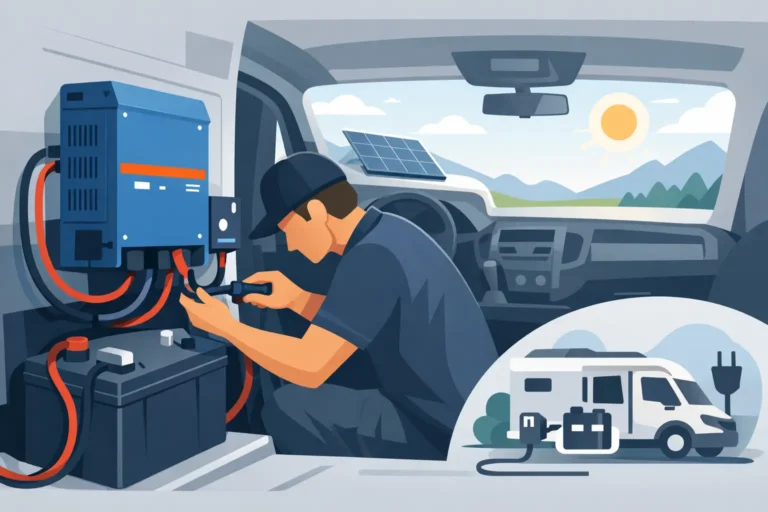
A DC-DC charger takes power from the vehicle’s charging system and converts it to the correct profile for the auxiliary lithium battery. This is often the right solution in modern vehicles, particularly those with smart alternators. In many newer 4WDs and utes, relying on a simple isolator is not enough because alternator voltage can drop too low for proper lithium charging.
A solar charger or regulator manages input from panels. With lithium, the regulator needs compatible settings and should be matched to both panel size and battery bank. In many touring setups, the best result comes from integrating solar with a DC-DC charger or a complete power management system rather than treating each component as a separate add-on.
Get the charging profile right
This is where a lot of problems start. A suitable lithium charger should have a proper lithium algorithm with the correct bulk and absorption voltage for LiFePO4. Some chargers also let you customise voltage settings, which can be useful in more advanced builds, but it needs to be done properly.
Equalisation mode is one feature to be careful with. That is a lead-acid charging function and should not be used on lithium batteries. Temperature compensation also works differently. With lead-acid batteries it is often a benefit, but with lithium it may need to be disabled or managed according to the battery manufacturer’s advice.
A charger with a dedicated lithium mode is generally the safer option for most vehicle owners. It takes the guesswork out and reduces the chance of settings being wrong.
Charger size matters, but bigger is not always better
Many people assume the highest amp rating is the best choice. Sometimes it is, but not always.
As a rough guide, charger output is often selected as a percentage of battery capacity. For example, a 20A charger may be reasonable for a 100Ah lithium battery, while a larger battery bank may benefit from 30A, 40A or more. The catch is that higher output means more demand on cabling, connections, input supply and heat management.
For a vehicle-based system, you also have to think about the alternator. Fitting an oversized DC-DC charger to a vehicle that mainly does short trips can create more problems than it solves. You might not get enough charging time to justify the size, and in some cases the alternator or wiring setup may not be happy carrying that load continuously.
On the other hand, a charger that is too small can leave a large battery bank undercharged after each day of travel. That is frustrating if you rely on the system for a fridge, lights, pumps, devices and inverter use while camping.
The practical answer is to size the charger around your battery bank, your charging sources and your normal travel pattern.
Vehicle compatibility is a big deal
When choosing a charger for a 4WD, ute or campervan, vehicle compatibility matters as much as battery compatibility. Modern smart alternators can reduce voltage once the cranking battery is topped up, which means the auxiliary battery may never get a proper charge without a DC-DC charger.
Euro vehicles and some newer models can be even more particular. Start-stop systems, voltage-sensitive electronics and factory charging strategies can all affect charger selection. This is one of those areas where the cheap universal option often ends up costing more in diagnosis and rework.
Good installation also matters. Even the best charger will underperform if cable size is too small, earth points are poor, fuses are incorrect or the charger is mounted where it runs too hot. Lithium systems are not just about buying quality gear. They need to be installed as a complete, matched system.
Think beyond the charger itself
If you are comparing chargers, look at the features that affect real-world use. Weather resistance matters in canopies, engine bays and caravans. Bluetooth monitoring can be genuinely useful if it helps you see charging behaviour and spot faults early. Solar input, ignition control, load ratings and integration with battery monitors can also make day-to-day use much easier.
Brand support matters too. When something goes wrong on a trip, clear documentation, local backup and proven reliability count for a lot. Premium systems are not always the cheapest upfront, but they often save headaches later, especially in off-grid setups where every component relies on the next one doing its job properly.
Common mistakes when choosing a lithium charger
The most common mistake is assuming any charger labelled lithium-compatible will do the job. Some are very basic, some have limited settings, and some are only suitable in certain applications.
Another mistake is upgrading the battery but keeping an old charging system that was designed around AGM. The battery may still work, but it may never charge properly or perform the way it should.
People also underestimate how much their travel style matters. If you stay in one spot for days, solar and 240V charging may matter more than a large DC-DC unit. If you are moving daily, the opposite can be true. That balance is what separates a setup that looks good on paper from one that works properly in the real world.
When to get advice before you buy
If your setup includes a smart alternator, multiple charging sources, inverter loads, solar, or a larger battery bank, it is worth getting advice before buying parts. The same goes if you are fitting out a caravan, canopy or camper for longer off-grid travel.
A good installer will look at the full system, explain the trade-offs and recommend a charger that fits the way you actually use the vehicle. That is usually better value than piecing together components based on online specs alone. For many Sunshine Coast vehicle owners, that means fewer surprises and a system that is ready for daily driving, work duties and weekends away.
The best charger is not the one with the biggest numbers or the flashiest packaging. It is the one that matches your lithium battery, your vehicle and the way you travel – and if you get that part right, the rest of the system has a much better chance of being dependable when you are a long way from home.