Car Aircon Leak Repair: What to Expect
When your air con starts blowing warm on a sticky Sunshine Coast afternoon, a regas might sound like the quick fix. But if the refrigerant has leaked out, topping it up without finding the fault is usually money spent twice. Proper car aircon leak repair starts with diagnosis, because the real issue is not that the system is low – it is why it went low in the first place.
That matters whether you drive a daily commuter, a work ute, a 4WD set up for touring, or a campervan that spends long days on the road. Air conditioning is not just about comfort. It helps demist the windscreen, keeps the cabin manageable in summer, and takes the edge off fatigue on longer trips.
Why car aircon leak repair is not just a regas
A vehicle air-conditioning system is sealed. Under normal conditions, it should not simply “use up” refrigerant like fuel or engine oil. If the gas level has dropped enough to affect cooling, there is usually a leak somewhere in the system.
That leak might be small and slow, or obvious and sudden. Either way, the fix is not guessing. A proper workshop will recover any remaining refrigerant, pressure test or trace the system, identify the leak point, and explain what needs to be replaced before recharging the system to the correct specification.
This is where people often get caught out. A cheap regas can look good upfront, but if the leak is still there, the cold air may last a week, a month, or one summer trip. Then you are back where you started, usually with another bill.
Common signs you may need car aircon leak repair
The most obvious sign is weak or warm air from the vents, especially when the fan is working properly but the cabin never really cools down. Sometimes the system still feels a bit cold at first, then fades as the refrigerant level drops further.
Another clue is the compressor cycling on and off more than normal. Low refrigerant can affect pressure readings, which changes how the system operates. You might also notice hissing near the engine bay, oily residue around air-con components, or a stale cabin because the system is no longer dehumidifying properly.
In some vehicles, especially those used for towing, touring, or stop-start work, the symptoms can seem inconsistent. It may cool while driving at speed but struggle in traffic or at idle. That does not always mean a leak, but it is one of the faults worth checking.
Where leaks usually happen
Not every leak comes from the same place, and age, use, vibration, salt air, and heat all play a part. On older vehicles, seals and O-rings can harden over time. On 4WDs and work vehicles, vibration and rough roads can stress fittings and hoses. Coastal conditions can also speed up corrosion on condensers and exposed components.
Hoses and seals
Flexible hoses and rubber seals are common trouble spots. They live in a hot engine bay, deal with pressure changes, and naturally wear over time. A tiny seal failure can be enough to slowly let refrigerant escape.
Condenser damage
The condenser sits at the front of the vehicle and takes plenty of punishment from road debris, insects, salt, and moisture. A stone strike or corrosion can create a pinhole leak that is hard to spot without testing.
Evaporator leaks
The evaporator is tucked away inside the dash, so leaks there are less visible and often more labour-intensive to repair. If found, this is one of the more involved jobs, simply because access takes time.
Compressor and service ports
Compressors can leak from shaft seals or housing points, and service valves can also fail. These may be straightforward fixes, but they still need proper confirmation before parts are changed.
How a workshop finds the leak
Good diagnostics save time. They also stop parts being replaced on a hunch.
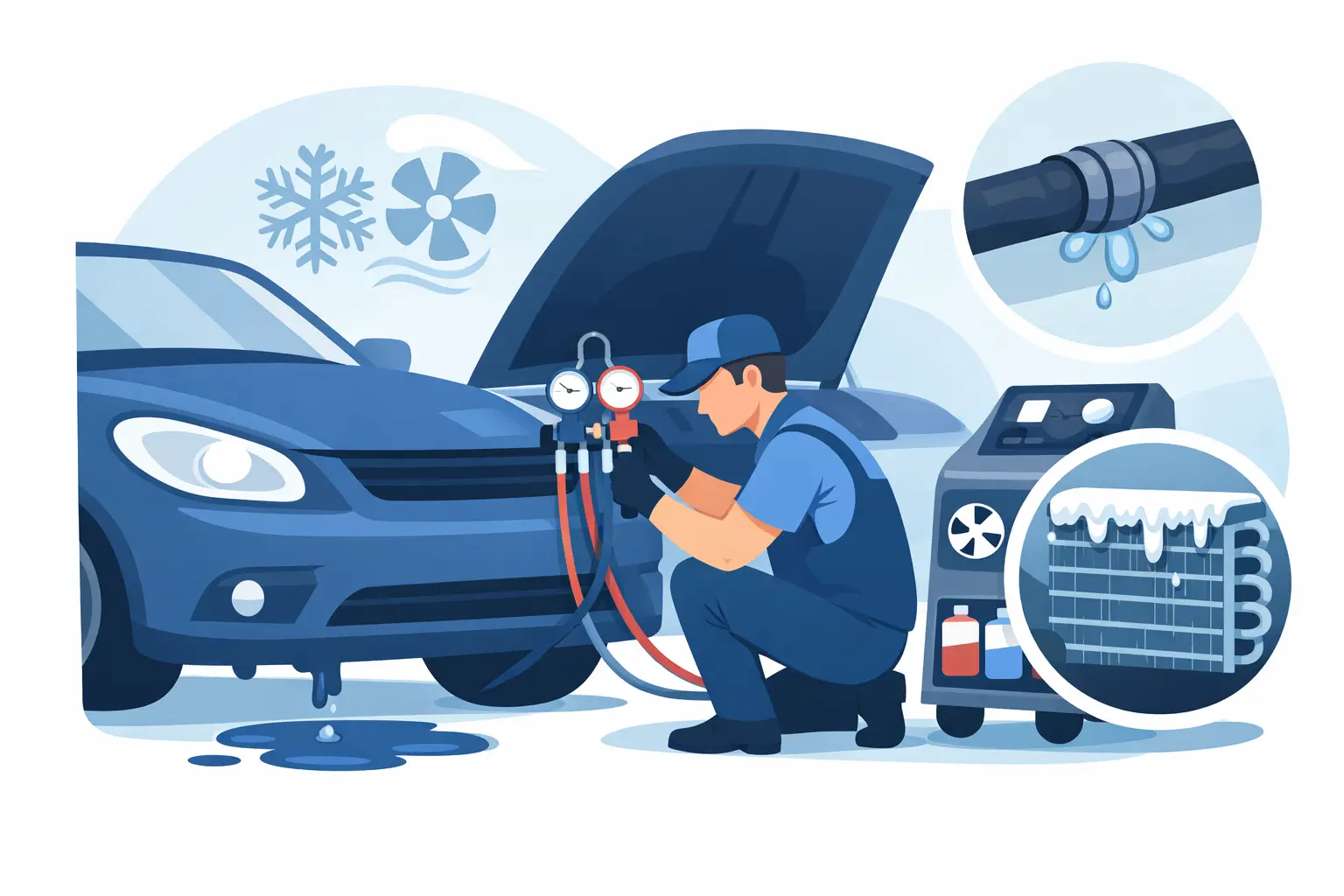
A qualified technician will usually start by checking system pressures and visual condition, then recover any remaining refrigerant safely. From there, several test methods can be used depending on the fault. UV dye may reveal where refrigerant oil is escaping. Nitrogen pressure testing can help locate leaks without introducing moisture. Electronic leak detectors are also useful for tracing smaller faults, particularly around fittings and hard-to-see components.
Sometimes the answer is obvious. Sometimes it takes a bit of methodical work to confirm the source. That is normal. Air-conditioning faults can be simple, but they can also be deceptive, especially when a system has been topped up before without the underlying issue being fixed.
What affects the repair cost
There is no single price for car aircon leak repair because the cost depends on where the leak is, what parts are involved, and how much labour is needed to access them.
A leaking O-ring or valve may be relatively minor. A damaged condenser is more substantial but often straightforward to replace. An evaporator leak behind the dash can be a bigger job due to the labour involved. If the compressor has failed internally, the repair may also include flushing the system and replacing other components to prevent contamination causing further trouble.
This is why clear diagnosis matters. It gives you a realistic picture before repairs go ahead. At a good workshop, the findings should be explained in plain language, along with what is urgent, what can wait, and what the likely outcome will be.
Why DIY fixes usually fall short
There is no shortage of off-the-shelf recharge kits and sealant products, but most are a poor substitute for proper testing and licensed handling. Refrigerant systems operate under pressure, and the gas must be recovered and recharged correctly. Sealants can also create bigger issues by contaminating equipment or masking the real problem for a short time.
The other issue is accuracy. Without proper gauges, leak detection tools, and system data, it is easy to misread the fault. What feels like low gas might also involve electrical control issues, condenser fan faults, pressure sensor problems, or a weak compressor. Air-con and auto electrical faults can overlap, which is why experience matters.
Repair or replace – it depends on the component
Not every leaking part should be repaired, and not every system needs major replacement work. The right answer depends on the age of the vehicle, the condition of the surrounding components, and whether the repair is likely to last.
For example, replacing a worn seal in an otherwise healthy system makes sense. Replacing one corroded part in a much older system may still be worthwhile, but only if the rest of the components are sound. If several parts are deteriorating at once, it can be more economical to tackle the problem more broadly rather than doing one temporary fix after another.
That is where practical advice counts. The best repair is not always the cheapest invoice today. It is the one that gives reliable cooling without sending you back for repeat work in a few months.
After the leak is fixed
Once the faulty part is replaced, the system should be evacuated properly to remove air and moisture, then recharged with the correct refrigerant type and quantity. Oil balance matters too. Too much or too little can affect performance and compressor life.
A final performance check should confirm vent temperature, system pressure, and general operation. If there are any related concerns, such as noisy fans, blocked condensers, or electrical issues affecting compressor command, they are best addressed at the same time rather than waiting for another breakdown.
For vehicles used in touring or family travel, this is worth doing properly before the next trip. Few things are more frustrating than losing cabin cooling halfway through a run north with the kids, the dog, and a fully loaded boot.
When to book it in
If the air con has noticeably weakened, stopped cooling, or needed topping up more than once, do not leave it until peak summer. A small leak can become a bigger one, and running a low system can put extra strain on the compressor.
It is also worth acting early if you have noticed oily residue around air-con components, inconsistent cooling, or poor demisting in wet weather. These are the sorts of faults that are usually easier and cheaper to deal with before they turn into compressor damage or repeated gas loss.
For drivers around the Sunshine Coast and hinterland, where heat, humidity, and long drives are part of normal life, reliable air conditioning is not a luxury. It is part of having a vehicle that does its job properly. If your system is losing refrigerant, the smartest move is to get the leak found first, repaired properly, and recharged to spec. That way, you are paying for a fix, not just another short-term top-up.
A good air-con repair should leave you with more than cold air. It should give you confidence the system will keep working when you actually need it.