
When Should Car Aircon Be Regassed?
You usually notice it on the first properly hot day. The fan is blowing, the controls seem normal, but the air coming through the vents is more warm than cool. That is when most people ask: when should car aircon be regassed? The short answer is not on a fixed calendar alone. A regas should be done when testing shows the refrigerant charge is low, cooling performance has dropped, or there has been a repair that opened the system.
A lot of drivers assume regassing is just routine maintenance, like an oil change. It is not quite that simple. Your vehicle’s air-conditioning is a sealed system, so if refrigerant is low, there is usually a reason. Sometimes it is minor, like natural loss over a long period. Sometimes it points to a leak, a failed seal, or another fault that a regas on its own will not fix.
When should car aircon be regassed in real terms?
For most vehicles, there is no universal rule that says the system must be regassed every one or two years. Some systems hold their charge well for years. Others start losing performance earlier, especially in older cars, work utes, 4WDs and touring vehicles that spend plenty of time in heat, dust and harsh conditions.
In practical terms, your car aircon should be regassed when the system is not cooling properly and testing confirms low refrigerant. That matters because poor cooling can also be caused by a worn compressor, blocked condenser, faulty pressure switch, cooling fan issue, electrical fault, or contamination in the system. If someone skips the testing and goes straight to the gas, there is a fair chance the real problem gets missed.
A proper workshop check is the difference between topping up a system that genuinely needs it and masking a fault that will return a few weeks later.
Signs your air-conditioning may need a regas
The most obvious sign is weak cooling. If the aircon used to get cold quickly and now struggles even with the fan on high, low refrigerant is one possible cause.
Another common sign is that the air starts cold, then fades warmer as you drive or sit in traffic. That can be related to refrigerant level, but it can also point to condenser airflow problems or fan issues. If you hear the compressor cycling on and off more often than normal, that can also happen when pressures are not where they should be.
You might also notice the demister is not working as well as it used to. Air-conditioning is not only about summer comfort. It also removes moisture from the cabin air, which helps clear fogged windows in humid or wet weather. If your demister performance has dropped, the system may not be working properly.
Then there is the smell factor. A regas will not fix musty odours coming from the vents. That is usually linked to bacteria, mould, a dirty cabin filter, or moisture build-up in the evaporator area. It is a good example of why aircon issues should be diagnosed properly rather than treated as all being the same problem.
A regas is not just a top-up
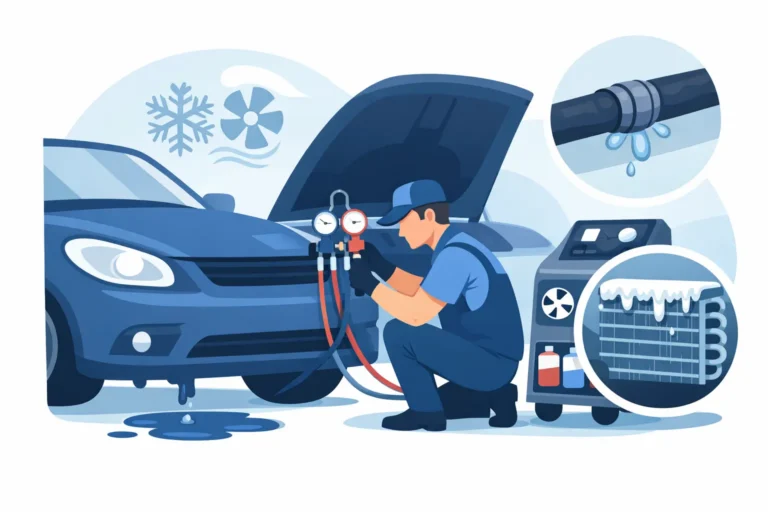
People often use the term regas to mean adding more refrigerant, but proper aircon servicing is a bit more involved. The system should be recovered, measured, vacuum tested and recharged to the manufacturer’s specification. That process helps confirm how much refrigerant was in the system, whether it is undercharged, and whether it can hold vacuum before recharge.
That matters because overcharging can be just as bad as undercharging. Too much refrigerant can raise system pressures, reduce performance and put extra strain on components. Modern vehicle air-conditioning systems are not guesswork jobs. Charge quantity matters.
A quality regas also includes checking pressures, vent temperatures and component operation. If there is a leak or mechanical issue, that should be explained before repairs go ahead.
How often should it happen?
If your aircon is working properly, there may be no reason to regas it on a set yearly schedule. That said, many vehicles do lose a small amount of refrigerant over time, and gradual performance drop is easy to miss because it happens slowly.
For everyday drivers, it is sensible to have the system checked if cooling has noticeably declined, if it has been several years since any aircon service, or before summer if the vehicle is used heavily. For 4WDs, caravans, campervans and travel vehicles, it can be worth checking the system before a long trip rather than waiting until you are halfway inland on a hot day.
Vehicles used for towing, off-road touring, trade work or family travel often work harder and spend more time in harsh heat. In those cases, a preventive inspection makes sense even if the air still feels reasonably cool.
Why aircon gas does not just disappear overnight
A sealed air-conditioning system is designed to retain refrigerant. So if a vehicle needs frequent regassing, there is almost certainly a leak somewhere. It might be at an O-ring, hose connection, condenser, compressor seal or evaporator. Stone damage to the condenser is also not unusual, especially on vehicles that see country roads or off-road use.
This is where there is a trade-off. If a system is only slightly low after many years, a regas may restore normal performance without drama. But if it is significantly low or empty, simply recharging it without looking for the cause is usually false economy. You may get cold air back for a short time, but the refrigerant can leak out again and the underlying fault remains.
If dye, electronic leak detection or pressure testing points to a leak, the better option is repair first, then recharge.
When should car aircon be regassed after repairs?
Any time the aircon system has been opened for repair, it should be evacuated and regassed correctly before being put back into service. That includes replacing parts like compressors, condensers, hoses, expansion valves or other sealed components.
It is also important after accident repairs if the condenser or front-end components have been disturbed. Even if the damage looked unrelated at first, air-conditioning parts can be affected more easily than many people realise.
If the repair included replacing major components, the system may also need the correct oil balance and additional checks to protect the new parts. That is another reason proper aircon work should be done carefully rather than treated as a quick add-on service.
Can you wait if the air is still a bit cool?
Sometimes yes, sometimes no. If the system is still cooling but clearly not as well as before, you may have a bit of time. But air-conditioning problems rarely fix themselves, and low refrigerant can reduce lubrication and place extra stress on the compressor.
If the vehicle is your daily transport, your work ute, or something you rely on for towing and travel, it is worth sorting out sooner rather than later. In the Sunshine Coast heat and humidity, marginal aircon can become no aircon very quickly when summer ramps up.
There is also the comfort and safety side of it. Good air-conditioning helps reduce driver fatigue, keeps kids and passengers more comfortable, and improves demisting in wet weather. It is not just a luxury feature.
What to expect from a proper aircon check
A decent aircon inspection should tell you more than whether the system feels cold. It should confirm vent temperature, operating pressures, refrigerant condition and whether the compressor and fans are behaving as they should.
If the system is low, you should be told that. If there are signs of a leak, contamination or a mechanical fault, that should be explained before more work is done. Clear advice matters because some jobs are straightforward and affordable, while others involve parts replacement and further testing.
That straight-up approach is what most vehicle owners want – know what is wrong, know what needs doing, and know whether a regas is actually the fix.
The best time to book it in
If your aircon is already struggling, book it in before peak summer if you can. Once the hotter months arrive, workshops often get flooded with last-minute cooling complaints. Getting ahead of the rush gives you more options and usually means less time sweating it out.
It also makes sense before a road trip, before towing the van, or before heading away in the camper. Few things wear thin faster than weak aircon on a long drive, especially when the vehicle is packed and the weather is ordinary.
If you are not sure whether it needs a regas or a repair, that is the right time to ask. A proper diagnosis is cheaper than guessing, and it gives you a clearer path forward. If the air from the vents has changed, the system is cycling oddly, or cooling has dropped off, get it checked before a small issue turns into a bigger one.